

The development has also brought renewed attention to several long-standing concerns, including vacant PG medical seats, exorbitant tuition fees in private medical colleges, compulsory service bonds, disparities in resident doctors’ stipends and the need to maintain minimum academic standards for postgraduate admissions.
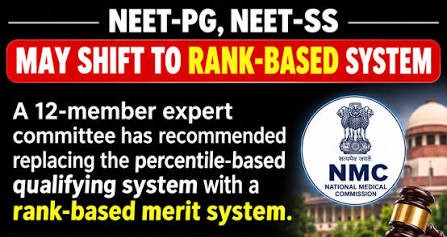
The issue was brought before the Supreme Court by a 12-member expert committee constituted by the Union Government to examine the existing NEET admission and counselling system and recommend measures to improve its functioning.
NMC’s Rank-Based Merit System: What Has Been Proposed?
Under the existing admission framework, NEET PG and NEET SS results are declared using percentile-based qualifying criteria. Candidates must secure the prescribed minimum qualifying percentile to become eligible for counselling and admission to postgraduate medical courses.
However, during successive counselling rounds, particularly when a considerable number of seats remain vacant, the qualifying percentile has sometimes been reduced by the competent authorities to make additional candidates eligible for admission.
The proposed rank-based system seeks to change this approach.
According to the proposal communicated by the NMC Secretary to the Directorate General of Health Services (DGHS) through a letter dated October 1, 2026, the Commission has accorded in-principle approval to replacing the existing percentile-based qualifying framework with a rank-based merit system for NEET PG and NEET SS.
Under the proposed arrangement:
- Candidates will be ranked according to their performance in the respective entrance examinations.
- The existing percentile-based result declaration system will be replaced by a rank-based merit framework.
- Percentile scores will no longer be declared in the examination results under the proposed arrangement.
- Counselling and admission will be conducted on the basis of candidates' ranks.
- NMC will issue draft regulations for comments and suggestions from relevant stakeholders before finalising the framework.
The proposed system is expected to make the admission process more predictable and reduce the need for repeated changes in qualifying cut-offs during counselling.
However, the precise eligibility provisions, minimum academic standards and operational details will become clear only after the draft regulations are published.
Why Is NMC Considering a Change in the NEET PG Merit System?
The proposal comes against the backdrop of repeated controversies surrounding the reduction of NEET PG qualifying cut-offs during counselling.
One of the major concerns has been the large number of postgraduate medical seats remaining vacant even after multiple rounds of counselling.
In several instances, authorities have reduced qualifying percentiles to enable more candidates to participate in subsequent counselling rounds and improve seat occupancy.
Although the practice has helped fill some vacant seats, it has also raised questions about the minimum academic standards expected from candidates entering postgraduate medical education.
The issue became particularly significant following the reduction of the NEET PG 2025–26 qualifying percentile for the third round of counselling.
In a notification dated January 13, 2026, the National Board of Examinations in Medical Sciences (NBEMS) revised the minimum qualifying criteria as follows:
| Category | Revised Qualifying Percentile | Revised Cut-off Score |
|---|---|---|
|
General/EWS |
7th percentile |
103 |
|
General PwBD |
5th percentile |
90 |
|
SC/ST/OBC, including PwBD of these categories |
0 percentile |
-40 |
The substantial reduction, particularly the negative qualifying score permitted for certain reserved categories, triggered objections and legal challenges.
The controversy eventually reached the Supreme Court, where questions were raised about the rationale behind lowering qualifying standards and the possible implications for postgraduate medical education.
The proposed rank-based system is being examined as one of the measures to address the recurring problems associated with the existing admission framework.
Supreme Court Takes Up NEET PG Cut-off Reduction Issue; Expert Committee Submits Recommendations
The rank-based merit proposal was brought to the attention of the Supreme Court during proceedings concerning a petition challenging the reduction of the NEET PG 2025–26 qualifying cut-off.
The matter was considered by a bench comprising Justices P.S. Narasimha and Alok Aradhe.
Following the concerns raised before the Court, the Union Government constituted a 12-member expert committee on July 23, 2026, under the chairmanship of DGHS Dr. Loveneesh G. Krishna.
The committee was assigned the responsibility of conducting a comprehensive review of the existing NEET admission and counselling framework, identifying shortcomings and recommending practical measures to improve the system.
The committee examined various aspects of medical admissions, including the responsibilities of NMC, NBEMS, NTA, MCC and state counselling authorities.
It also reviewed issues relating to vacant seats, counselling delays, qualifying criteria, seat matrix preparation and the need for greater coordination among regulatory and admission authorities.
During the November 3, 2026, hearing, the expert committee informed the Supreme Court about NMC's in-principle decision to introduce a rank-based merit system for NEET PG and NEET SS.
The proposed regulatory change was also included among the recommendations and future reforms discussed by the committee.
The Court took the report on record and sought responses from the parties concerned.
United Doctors Front Questions Whether Rank-Based Merit Will Address Fundamental Problems
The United Doctors Front (UDF) has expressed serious reservations about the proposed transition from a percentile-based to a rank-based admission system.
The association has questioned whether the proposed change represents a meaningful reform of postgraduate medical education or merely a modification of the mechanism used to prepare merit lists.
Dr. Lakshya Mittal, Chairperson of UDF, stated that several important recommendations submitted by stakeholders during consultations with the government have yet to receive adequate attention.
During a meeting convened by the Directorate General of Health Services on October 9, 2026, under the chairmanship of Additional DGHS Dr. Nita Khurana, UDF had highlighted several long-pending structural issues affecting postgraduate medical education.
The association argued that the focus should be on addressing the reasons why thousands of postgraduate medical seats, particularly in certain non-clinical and private medical college specialities, remain vacant.
Major Recommendations Submitted by UDF
UDF had put forward several recommendations aimed at making postgraduate medical education more affordable, attractive and accessible.
1. Effective Fee Regulatory Committees
The association called for the establishment and strengthening of effective fee regulatory committees to ensure transparency and reasonable tuition fees in medical colleges.
It highlighted the considerable differences in postgraduate medical education fees across neighbouring states and the financial difficulties faced by doctors seeking admission to private medical institutions.
The association believes that appropriate fee regulation is essential to prevent excessive financial burdens on postgraduate medical aspirants.
2. Bond-Free Admissions in Pre-Clinical and Para-Clinical Specialities
UDF recommended that candidates opting for pre-clinical, para-clinical and non-clinical postgraduate specialities should be considered for exemption from compulsory service bonds.
According to the association, mandatory bonds can discourage doctors from selecting certain specialities, particularly when seats in these branches frequently remain vacant.
Removing or rationalising such conditions could encourage more eligible candidates to opt for these essential disciplines.
3. Improvement and Uniformity in Resident Doctors' Stipends
Another important recommendation concerned the substantial disparity in stipends paid to postgraduate resident doctors across different states and medical institutions.
UDF called for a significant enhancement and greater uniformity in stipends, particularly in pre-clinical, para-clinical and non-clinical branches.
The association believes that fair remuneration would improve the attractiveness of these specialities and provide better financial support to postgraduate medical students.
4. Improved Faculty Recruitment and Career Progression
The association also emphasised the need to strengthen faculty recruitment, career advancement opportunities and research facilities.
According to UDF, improving the overall academic environment in medical colleges is necessary to ensure quality postgraduate training and strengthen the medical education ecosystem.
Dr. Mittal questioned how merely changing the methodology of preparing merit lists could resolve problems involving high tuition fees, inadequate stipends, compulsory bonds and the declining interest in certain postgraduate specialities.
He maintained that a rank-based system may have its own advantages and deserves academic and technical consideration. However, it should not be presented as a comprehensive solution to the problems affecting postgraduate medical education.
UDF has urged the Union Ministry of Health and Family Welfare, NMC and other concerned authorities to clarify the status of the recommendations submitted by stakeholders and provide a concrete roadmap for their implementation.
FORDA Representative Welcomes the Discussion but Flags Concerns Over Academic Standards
Dr. Aviral Mathur, former President of the Federation of Resident Doctors Association (FORDA) and currently a consultant at Sir Ganga Ram Hospital, described the proposed change as a long-overdue discussion.
According to him, the existing counselling framework has repeatedly witnessed a similar sequence of events: postgraduate seats remain vacant, qualifying cut-offs are reduced during later counselling rounds, legal petitions are filed and the admission schedule gets delayed.
He believes that a rank-based system could help eliminate the need for last-minute qualifying percentile reductions and make the counselling schedule more predictable for candidates.
Dr. Mathur also acknowledged the role of Advocate Satyam Singh Rajput, who filed the petition challenging the reduction of the January 2026 qualifying cut-off.
The petition brought the issue of minimum qualifying standards and changes to admission rules during counselling under judicial scrutiny, eventually leading the Supreme Court to seek a comprehensive examination of the admission system.
Concerns Regarding Minimum Qualifying Standards
Despite acknowledging the potential advantages of the proposed system, Dr. Mathur highlighted an important concern regarding the academic standards required for postgraduate medical admissions.
He observed that if the proposed system does not retain an appropriate qualifying threshold, the draft regulations must clearly explain how the academic competence of candidates will be ensured.
One argument supporting the proposed approach is that candidates have already completed their MBBS education before appearing for NEET PG, while their postgraduate training will subsequently be assessed through the relevant exit examinations.
However, Dr. Mathur emphasised that such safeguards should be clearly incorporated into the regulations rather than being left implied.
He also pointed out that a change in the ranking mechanism alone would not resolve the issue of vacant seats.
According to him, a significant proportion of vacant seats are concentrated in non-clinical specialities and private medical colleges where high tuition fees and compulsory service bonds discourage candidates from accepting admission.
He stressed that the expert committee's recommendations concerning fee rationalisation and bond exemptions are equally important and should be implemented alongside any changes to the merit system.
Dr. Mathur further called for wider circulation of the draft regulations and meaningful consultation with resident doctors' associations, including FORDA, before the proposed framework is finalised.
IMA JDN Raises Questions About Merit and Qualifying Standards
Dr. Dhruv Chauhan, National Spokesperson of the Indian Medical Association Junior Doctors Network (IMA JDN) and Founder and Chairperson of the Legal Cell for All India Doctors, also raised concerns regarding the proposed transition.
He observed that the recommendation to replace percentile-based qualifying criteria with a rank-based system from 2027 must be examined carefully, particularly in view of the controversy surrounding the drastic reduction in qualifying cut-offs.
According to Dr. Chauhan, changing the examination and ranking methodology does not automatically resolve the questions raised about lowering minimum qualifying standards.
He also referred to the intervention of Advocate Satyam Singh Rajput during the legal proceedings and questioned what substantive difference the proposed transition would make to the overall admission process.
Dr. Chauhan emphasised that vacant postgraduate medical seats should not become a justification for compromising merit, diluting academic standards or experimenting with the future of medical education.
His position reflects the concerns of a section of the medical fraternity that believes reforms must strike a balance between filling vacant seats and preserving the quality and credibility of postgraduate medical admissions.
What Other Reforms Has the Expert Committee Recommended for NEET PG Counselling?
The proposed rank-based merit system is only one component of the broader reform exercise undertaken by the 12-member expert committee.
The committee has also discussed several measures intended to improve the transparency, efficiency and predictability of the counselling process.
Some of the important recommendations and proposed measures include:
| Proposed Reform | Details |
|---|---|
|
Digitalisation of Counselling |
MCC plans to further digitise the counselling process and minimise manual intervention to improve transparency and accountability. |
|
Stakeholder Consultations |
Meetings are proposed before and after counselling to identify problems, address technical issues and improve future admission processes. |
|
Timely Seat Matrix Preparation |
NMC is expected to provide verified seat information on the MCC portal well before counselling begins. |
|
Fee Rationalisation |
State fee-fixation committees may consider lower fees for non-clinical postgraduate specialities compared with clinical branches. |
|
Bond Exemption |
Candidates opting for pre-clinical and para-clinical specialities may be considered for exemption from compulsory service bonds. |
|
Maintaining Minimum Standards |
The sanctity of NEET and the minimum academic standards required for postgraduate admissions should be protected. |
|
Comprehensive Counselling Audit |
The existing admission system should be examined to identify shortcomings and develop practical solutions. |
Digitalisation of the MCC Counselling Process
The Medical Counselling Committee has been working towards further digitalisation of the counselling system to reduce manual intervention and improve the accuracy of seat allocation.
The expert committee noted that NMC has already been incorporated into the MCC counselling software as a stakeholder responsible for directly contributing approved seat details for individual institutions.
This integration has helped improve the accuracy of seat matrix information and reduce the possibility of duplicate seat entries.
For the next academic year, NMC is expected to provide approved seat details on the MCC portal well before the commencement of counselling.
The move is intended to reduce delays caused by discrepancies in seat information and improve coordination between regulatory and counselling authorities.
Lower Fees for Non-Clinical Postgraduate Courses
One of the important recommendations concerns the fee structure of clinical and non-clinical postgraduate courses.
The MCC has suggested that state fee-fixation committees and competent authorities consider a difference in fee structures between these categories.
The fee for non-clinical postgraduate branches could be comparatively lower to encourage candidates to accept seats in these specialities.
This recommendation is based on the concern that high fees in certain institutions discourage candidates from opting for courses in which seats frequently remain vacant.
Exemption from Service Bonds
The committee has also discussed the possibility of exempting candidates admitted to pre-clinical and para-clinical postgraduate specialities from compulsory service bonds.
The recommendation aims to remove one of the potential barriers preventing doctors from selecting these branches.
If implemented, the measure could improve the acceptance of seats in specialities that traditionally experience lower demand.
However, these measures remain recommendations and should not be treated as implemented admission rules.
Will Rank-Based NEET PG Merit Eliminate Vacant Seats?
One of the biggest questions surrounding the proposed reform is whether replacing percentile-based merit with rank-based merit will actually solve the problem of vacant postgraduate medical seats.
The medical fraternity appears divided on this issue.
Supporters believe that the proposed mechanism could reduce administrative complications arising from repeated changes in qualifying cut-offs. It may also help authorities conduct counselling within a more predictable timeframe.
However, doctors opposing the idea of treating this as a comprehensive reform argue that the reasons behind vacant seats are much deeper.
The major factors contributing to vacant PG medical seats include:
- High tuition fees in private medical colleges.
- Significant differences in fees between states and institutions.
- Compulsory service bonds and other admission-related obligations.
- Inadequate or unequal stipends for postgraduate resident doctors.
- Lower preference for certain pre-clinical and para-clinical specialities.
- Limited career progression and research opportunities in some disciplines.
- Differences in the perceived professional and financial attractiveness of various specialities.
These concerns indicate that improving the counselling mechanism alone may not be sufficient to ensure that all postgraduate medical seats are filled.
A comprehensive approach involving affordable medical education, better working conditions, improved stipends, transparent fee regulation and stronger academic infrastructure may be necessary.
Rank-Based Merit System: What Will Change for NEET PG and NEET SS Aspirants?
If the proposal is approved through the final regulations, the new framework could bring important changes for candidates appearing in NEET PG and NEET SS from the 2027 admission cycle.
Under the existing system, candidates receive percentile scores and qualifying status based on the prescribed category-wise eligibility criteria.
Under the proposed framework, merit will be determined through ranks, and percentile scores will no longer be declared in the results.
For aspirants, some important implications may include:
1. Greater Focus on Relative Merit: Candidates will be assessed through their position in the overall merit ranking rather than the existing percentile-based qualifying framework.
2. Changes in Result Declaration: The proposed system envisages declaring ranks instead of percentile scores.
3. Possible Reduction in Cut-off Controversies: The rank-based framework aims to reduce the recurring need for last-minute percentile reductions during counselling.
4. More Predictable Counselling: A simplified merit mechanism could help authorities plan and complete counselling within a more structured schedule.
5. Continued Importance of Academic Standards: The final regulations will need to clarify the qualifying and eligibility safeguards to ensure that postgraduate admission standards are maintained.
Candidates should understand that the proposed framework has not yet become a final admission regulation. The existing rules will continue to apply unless and until the competent authorities formally notify the revised regulations.
When Will the New NEET PG and NEET SS Rank-Based System Be Implemented?
The NMC's proposal is being considered for the 2027 admission cycle.
The Commission has already accorded in-principle approval to the change and communicated its decision to DGHS through a letter dated October 1, 2026.
The 12-member expert committee subsequently informed the Supreme Court about the proposed reform during the November 3 hearing.
The next important step will be the publication of draft regulations by NMC, inviting comments and suggestions from stakeholders, including medical colleges, resident doctors' associations and other concerned organisations.
Following the consultation process, the Commission will have to finalise and formally notify the relevant regulatory provisions.
Until then, the rank-based system should be understood as a proposed policy change rather than an implemented admission mechanism.
What Should NEET PG and NEET SS Aspirants Do Now?
Candidates preparing for NEET PG and NEET SS should continue their preparation according to the existing examination and admission framework until an official notification announces changes.
Aspirants should keep the following points in mind:
- Continue preparing for the entrance examinations based on the existing syllabus and examination pattern.
- Follow official announcements from NMC and NBEMS regarding the proposed regulatory changes.
- Do not assume that percentile scores or existing qualifying provisions have already been discontinued.
- Watch for the publication of the draft regulations and the subsequent stakeholder consultation process.
- Review official admission guidelines before participating in counselling.
- Keep track of updates relating to seat availability, tuition fees, service bonds and other admission conditions.
The final regulations will be particularly important in determining how the proposed rank-based framework will operate and what eligibility conditions will apply to candidates.
Conclusion: Rank-Based Merit May Simplify Counselling, but Structural Reforms Remain Essential
The NMC's proposal to introduce a rank-based merit system for NEET PG and NEET SS represents a significant potential change in India's postgraduate medical admission framework.
The proposal has received a mixed response from doctors. While some believe it could reduce repeated qualifying cut-off revisions, minimise counselling delays and make the admission process more predictable, others argue that the change does not address the fundamental issues responsible for vacant postgraduate medical seats.
The concerns raised by UDF, FORDA representatives and IMA JDN highlight the need for a broader reform agenda involving reasonable tuition fees, better stipends, rationalised service bonds, improved faculty recruitment and stronger academic opportunities.
The central challenge for policymakers will be to strike a balance between filling vacant postgraduate medical seats and maintaining the quality, credibility and academic standards of medical education.
The proposed rank-based system could be an important step towards improving counselling efficiency. However, its success will ultimately depend on the final regulatory framework and the extent to which the government and medical education authorities address the structural concerns raised by the medical fraternity.
For now, NEET PG and NEET SS aspirants should await the draft NMC regulations and subsequent official notifications before treating the proposed changes as final.
