

The Joint Entrance Examination (JEE) Advanced is considered one of India's most challenging engineering entrance examinations. It is conducted for admission to undergraduate programmes offered by the Indian Institutes of Technology (IITs) and other participating institutions. Every year, lakhs of aspirants compete for a limited number of seats, but only a fraction qualify for inclusion in the rank list.
In JEE Advanced 2026, a total of 1,79,694 candidates appeared in both papers, of whom 56,880 candidates qualified. Shubham Kumar of the IIT Delhi zone emerged as the AIR 1 holder, scoring 330 marks out of 360. He was followed by Kabeer Chhillar, who secured AIR 2 with 329 marks.
The latest result also provides an opportunity to examine how the AIR 1 score has changed over the years and why the marks of toppers should not be used as a fixed benchmark for future JEE Advanced aspirants.
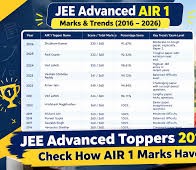
JEE Advanced AIR 1 Score Trend: 2016 to 2026
The following table presents the AIR 1 holder, score and maximum marks for each examination year from 2016 to 2026:
| Year | AIR 1 Holder | Score | Maximum Marks |
|---|---|---|---|
|
2016 |
Aman Bansal |
320 |
372 |
|
2017 |
Sarvesh Mehtani |
339 |
366 |
|
2018 |
Pranav Goyal |
337 |
360 |
|
2019 |
Kartikey Gupta |
346 |
372 |
|
2020 |
Chirag Falor |
352 |
396 |
|
2021 |
Mridul Agarwal |
348 |
360 |
|
2022 |
R K Shishir |
314 |
360 |
|
2023 |
Vavilala Chidvilas Reddy |
341 |
360 |
|
2024 |
Ved Lahoti |
355 |
360 |
|
2025 |
Rajit Gupta |
332 |
360 |
|
2026 |
Shubham Kumar |
330 |
360 |
The figures demonstrate that the AIR 1 score has not followed a consistent upward or downward trajectory. Instead, it has moved considerably depending on the structure and difficulty level of the examination.
Aman Bansal: JEE Advanced AIR 1 in 2016
Aman Bansal secured the top position in JEE Advanced 2016 with 320 marks out of 372.
His subject-wise performance was:
- Physics: 113 marks
- Chemistry: 105 marks
- Mathematics: 102 marks
- Total: 320 marks
Bansal's result placed him at the top of the national merit list and highlighted the high level of consistency required across all three subjects.
At the time, he had expressed his ambition to pursue Computer Science at IIT Bombay, a preference that has remained common among many of the country's top JEE Advanced rankers.
Sarvesh Mehtani Took AIR 1 in 2017
In 2017, Sarvesh Mehtani secured AIR 1 with 339 marks out of 366.
His subject-wise scores were:
- Physics: 104
- Chemistry: 115
- Mathematics: 120
- Total: 339
Mathematics was his strongest subject that year, contributing 120 marks to his overall score.
The increase from Aman Bansal's 320 marks in 2016 to 339 in 2017 should not, however, be interpreted simply as evidence that the 2017 paper was easier. The maximum marks themselves changed, and the difficulty and marking structure of JEE Advanced can vary from one year to another.
Pranav Goyal: AIR 1 in 2018
Pranav Goyal topped JEE Advanced 2018 with 337 marks out of 360.
His subject-wise performance was:
- Physics: 117
- Chemistry: 114
- Mathematics: 106
- Total: 337
Goyal demonstrated particularly strong performance in Physics and Chemistry, while also maintaining a high score in Mathematics.
The 2018 AIR 1 score of 337 represented a very high proportion of the total marks available that year.
Kartikey Gupta Topped JEE Advanced in 2019
In 2019, Kartikey Gupta secured AIR 1 with 346 marks out of 372.
His subject-wise scores were:
- Physics: 113
- Chemistry: 112
- Mathematics: 121
- Total: 346
Mathematics emerged as his strongest subject, with 121 marks.
The 2019 examination had a maximum aggregate of 372 marks, once again illustrating why direct comparison of raw marks between different JEE Advanced editions can be misleading.
Chirag Falor Secured AIR 1 in 2020
The 2020 JEE Advanced AIR 1 score was 352 out of 396, secured by Chirag Falor.
His subject-wise marks were:
- Physics: 110
- Chemistry: 118
- Mathematics: 124
- Total: 352
Falor's 352 marks were among the highest raw AIR 1 scores recorded during the period.
The year 2020 is particularly notable because the examination had a maximum score of 396, unlike the 360-mark format used in several other years.
Mridul Agarwal: Record-Level Performance in 2021
Mridul Agarwal topped JEE Advanced 2021 with 348 marks out of 360.
His subject-wise marks were:
- Physics: 120
- Chemistry: 112
- Mathematics: 116
- Total: 348
His score represented an exceptionally high percentage of the total marks available.
Agarwal's performance came after the pandemic-era disruption to academic schedules and examination preparation, making the result particularly noteworthy.
R K Shishir Had the Lowest AIR 1 Score in the Period
One of the most striking changes occurred in 2022, when R K Shishir secured AIR 1 with 314 marks out of 360.
His subject-wise scores were:
- Physics: 96
- Chemistry: 109
- Mathematics: 109
- Total: 314
The 314-mark score was the lowest AIR 1 raw score recorded between 2016 and 2026.
This does not mean that Shishir's performance was weaker than that of other AIR 1 candidates. Rather, it highlights how strongly JEE Advanced marks depend on the difficulty level and structure of a particular year's examination.
Vavilala Chidvilas Reddy: AIR 1 in 2023
The AIR 1 score rose sharply in 2023.
Vavilala Chidvilas Reddy secured the top rank with 341 marks out of 360.
His subject-wise scores were:
- Physics: 110
- Chemistry: 117
- Mathematics: 114
- Total: 341
The score was 27 marks higher than the previous year's AIR 1 score of 314.
This substantial year-on-year variation demonstrates why students should not use the previous year's topper score as a direct target without considering the examination pattern.
Ved Lahoti Recorded the Highest AIR 1 Score in 2024
Ved Lahoti achieved one of the strongest performances in the history of the recent JEE Advanced examination cycle, securing AIR 1 in 2024 with 355 marks out of 360.
His subject-wise marks were:
- Physics: 118
- Chemistry: 120
- Mathematics: 117
- Total: 355
The 355/360 score remains the highest raw AIR 1 score recorded in the 2016-2026 period covered in this comparison.
Lahoti's performance was remarkably balanced, with at least 117 marks in each of the three subjects.
Rajit Gupta Secured AIR 1 in 2025
In 2025, Rajit Gupta secured the top rank with 332 marks out of 360.
His subject-wise performance was:
- Physics: 116
- Chemistry: 105
- Mathematics: 111
- Total: 332
The score was 23 marks lower than Ved Lahoti's 2024 AIR 1 score.
Again, the difference illustrates the importance of the paper's difficulty and marking structure when comparing scores between consecutive years.
Shubham Kumar Tops JEE Advanced 2026
The latest addition to the decade-long AIR 1 list is Shubham Kumar, who secured the top rank in JEE Advanced 2026.
The student from Gaya, Bihar, scored 330 out of 360.
His subject-wise marks were:
- Physics: 98
- Chemistry: 120
- Mathematics: 112
- Total: 330
Shubham's score was just one mark ahead of Kabeer Chhillar, who secured AIR 2 with 329 marks.
Shubham had also performed exceptionally well in JEE Main 2026, where he secured the 100th percentile and ranked sixth nationally. He subsequently emerged as the top performer in JEE Advanced.
The 18-year-old aspirant had moved to Kota after Class 10 to prepare for the engineering entrance examinations. He has expressed his ambition to pursue Computer Science and Engineering at IIT Bombay.
JEE Advanced AIR 1 2026: Subject-Wise Analysis
Shubham Kumar's 330 marks came from a strong performance across all three subjects.
| Subject | Marks |
|---|---|
|
Physics |
98 |
|
Chemistry |
120 |
|
Mathematics |
112 |
|
Total |
330 |
His strongest subject was Chemistry, in which he scored a perfect 120 marks according to the published subject-wise data.
Mathematics contributed 112 marks, while Physics accounted for 98 marks.
The distribution shows that an AIR 1 performance does not necessarily require identical marks across Physics, Chemistry and Mathematics. Instead, the overall score and rank depend on a candidate's combined performance.
Highest and Lowest AIR 1 Scores from 2016 to 2026
The decade-long comparison reveals two particularly notable figures.
Highest AIR 1 Score: 355
The highest raw AIR 1 score during the period was recorded by Ved Lahoti in 2024, who scored:
355/360
This represents approximately 98.61% of the maximum marks.
Lowest AIR 1 Score: 314
The lowest AIR 1 score in the period was recorded by R K Shishir in 2022:
314/360
This represents approximately 87.22% of the maximum marks.
The difference between these two scores is 41 marks, highlighting the extent to which AIR 1 marks can fluctuate.
How Shubham Kumar's Score Compares With Previous AIR 1 Marks
Shubham Kumar's 330/360 score in 2026 was:
- 16 marks lower than the 2024 AIR 1 score of 355
- 2 marks lower than the 2025 AIR 1 score of 332
- 11 marks lower than the 2023 AIR 1 score of 341
- 16 marks higher than the 2022 AIR 1 score of 314
- 18 marks lower than the 2021 AIR 1 score of 348
- 22 marks lower than the 2020 raw AIR 1 score of 352, although the maximum marks in 2020 were 396
This comparison shows that Shubham's 330 marks fall comfortably within the broad range of AIR 1 scores recorded over the last decade.
Why JEE Advanced AIR 1 Marks Change Every Year
One of the biggest misconceptions among JEE Advanced aspirants is that a higher AIR 1 score necessarily means a more difficult or easier examination.
In reality, several factors affect the final score.
1. Difficulty Level
If the question paper is more difficult, even the AIR 1 candidate may score substantially fewer marks.
The 2022 result is a strong example, with the AIR 1 score falling to 314 out of 360.
2. Maximum Marks
JEE Advanced does not necessarily have the same maximum aggregate marks every year.
For example:
- 2016: 372
- 2017: 366
- 2018: 360
- 2019: 372
- 2020: 396
- 2021 onward in this comparison: 360
Therefore, comparing only raw marks can produce misleading conclusions.
3. Question Pattern
The number and types of questions, marking schemes and distribution of marks can change.
Such changes directly influence how many marks candidates can obtain.
4. Subject Difficulty
A particular year may have a relatively difficult Physics section but easier Chemistry or Mathematics sections, or vice versa.
This can affect the overall score distribution.
5. Negative Marking
JEE Advanced may include different marking rules for different question types. Candidates must therefore balance attempts and accuracy carefully.
JEE Advanced AIR 1 Score Is Not a Fixed Target
The 2016-2026 data provides an important lesson for future aspirants: there is no fixed score that guarantees AIR 1 in JEE Advanced.
A candidate who scores 330 in one year could potentially receive a very different rank in another year because the difficulty level and overall performance distribution change.
Similarly, scoring 350 or more does not automatically guarantee the same percentile or rank across different editions.
Students should therefore focus on maximising their own score relative to the actual examination paper, rather than preparing around an arbitrary previous-year topper score.
What Should Future JEE Advanced Aspirants Learn From the Toppers?
The decade-long trend provides several useful lessons.
Focus on All Three Subjects
The AIR 1 data shows that toppers generally perform strongly across Physics, Chemistry and Mathematics.
Students should avoid completely neglecting a subject simply because another subject is their strength.
Accuracy Matters
JEE Advanced rewards candidates who can solve difficult problems accurately. Random guessing or excessive attempts can be counterproductive when negative marking applies.
Practise Different Question Types
Because JEE Advanced changes its question structure and marking patterns, students should practise a broad range of problems rather than memorising one fixed format.
Do Not Chase Previous-Year Scores
The 314 score in 2022 and 355 score in 2024 both resulted in AIR 1 in their respective years. This is perhaps the clearest evidence that the required score changes with the paper.
Build Examination Temperament
Toppers need not only strong conceptual knowledge but also the ability to remain calm and make sound decisions under intense examination pressure.
JEE Advanced AIR 1: 10-Year Trend Shows No Fixed Benchmark
The AIR 1 score trend from Aman Bansal to Shubham Kumar demonstrates that JEE Advanced is an examination where rank is more meaningful than raw marks when comparing different years.
The highest score in the 2016-2026 period was 355/360 in 2024, while the lowest was 314/360 in 2022. Shubham Kumar's 2026 score of 330/360 sits between these extremes.
The variation is primarily a reflection of differences in maximum marks, question-paper structure, difficulty and marking schemes.
For students preparing for future JEE Advanced examinations, the key lesson is clear: previous AIR 1 marks can provide historical context, but they should not be treated as an absolute target.
JEE Advanced AIR 1 Scores: Final Takeaway
From Aman Bansal's 320 marks in 2016 to Shubham Kumar's 330 marks in 2026, JEE Advanced AIR 1 scores have shown significant fluctuations. During this period, the highest recorded raw AIR 1 score was 355/360 by Ved Lahoti in 2024, while the lowest was 314/360 by R K Shishir in 2022.
The latest topper, Shubham Kumar, secured AIR 1 in JEE Advanced 2026 with 330/360, scoring 98 in Physics, 120 in Chemistry and 112 in Mathematics.
The 10-year comparison makes one point particularly clear: JEE Advanced topper marks cannot be compared purely on the basis of raw scores. Changes in maximum marks, question difficulty, paper structure and marking schemes can substantially alter the final score distribution.
For JEE Advanced aspirants, the more effective strategy is to build strong concepts, practise challenging problems, improve accuracy and develop the ability to adapt to different examination patterns. Rather than targeting the previous year's AIR 1 score, students should aim to maximise their performance on the paper they actually face.
