

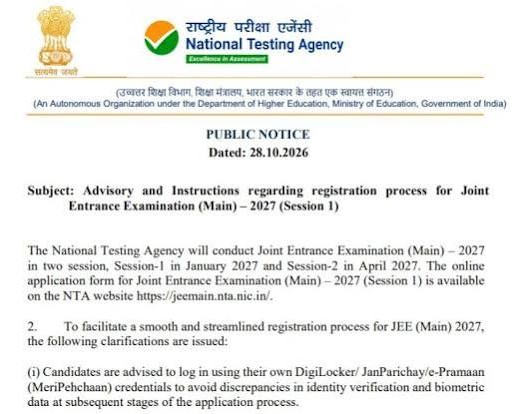
The advisory, dated October 28, 2026, comes as the registration process for JEE Main 2027 Session 1 is underway. The examination authority has emphasised that candidates should verify their personal information before filling out the online application form to minimise identity-verification problems and discrepancies during subsequent stages of the examination process.
JEE Main is one of India's most important engineering entrance examinations. It is used for admission to undergraduate engineering programmes at National Institutes of Technology (NITs), Indian Institutes of Information Technology (IIITs) and other participating institutions. It is also the qualifying examination for candidates seeking to appear for JEE Advanced, subject to the prescribed eligibility requirements.
With thousands of aspirants preparing to complete their applications, the latest instructions make it essential for candidates and their parents to understand the registration requirements, the purpose of Re-KYC, the importance of accurate academic records and the steps involved in completing the application.
JEE Main 2027 Registration: Important Dates
Candidates applying for the January session should take note of the following schedule.
| Event | Date |
|---|---|
|
JEE Main 2027 Session 1 registration begins |
October 24, 2026 |
|
Last date to submit the application form without a late fee |
November 22, 2026 |
|
Application and fee-payment window with late fee |
November 23–26, 2026 |
|
Last date for application fee payment, including the late-fee period |
November 26, 2026 |
|
Application correction window |
November 27–29, 2026 |
|
Advance examination city intimation slip |
December 30, 2026 |
|
Admit card release |
January 13, 2027 |
|
JEE Main 2027 Session 1 examination |
January 20, 21, 22, 23, 24 and 28, 2027 |
Candidates should check the official information bulletin for the complete schedule and any subsequent amendments.
Official website: https://jeemain.nta.nic.in/
Online application portal: https://examinationservices.nic.in/JeeMaink2027/root/Home.aspx
What Has NTA Said in Its Latest JEE Main 2027 Advisory?
The latest advisory highlights three important requirements that candidates should follow while registering for JEE Main 2027 Session 1.
1. Use personal DigiLocker or designated digital identity credentials
Candidates have been advised to log in using their own credentials for DigiLocker, JanParichay or e-Pramaan (MeriPehchaan).
Applicants should not use another person's digital identity account to complete their registration. The account and identity information used during the process should belong to the candidate.
The purpose of this instruction is to help minimise discrepancies during identity verification and biometric authentication at subsequent stages of the examination process.
2. Complete Re-KYC through DigiLocker before filling out the application
NTA has advised candidates to complete the required Re-KYC process through DigiLocker before proceeding with the JEE Main 2027 online application form.
Re-KYC helps refresh the identity information available through the digital document platform so that the latest eligible details can be fetched during registration.
Candidates should complete the verification process in advance rather than waiting until the final days of registration.
3. Ensure that name and date of birth match Class 10 records
Another important instruction concerns the accuracy of personal details entered in the application form.
NTA has stated that the candidate's name and date of birth in the JEE Main 2027 application must match the information mentioned on the Class 10 certificate or marksheet.
Candidates should carefully verify these details before submitting their applications. Inconsistent information can create difficulties during document verification and other examination-related procedures.
What Is DigiLocker Re-KYC, and Why Is It Important?
DigiLocker is a Government of India digital platform that allows users to access and store documents issued by participating government departments, educational institutions and other authorised organisations.
Re-KYC refers to the process of refreshing or revalidating identity information so that the latest details can be retrieved and verified.
For JEE Main registration, the process is important because the application system may rely on digitally verified identity information. If the information available through a candidate's digital account is outdated or inconsistent with the relevant official records, the applicant may encounter difficulties while completing registration.
Completing Re-KYC before starting the application can help candidates identify and address issues early.
However, candidates should understand that Re-KYC does not automatically correct errors in every underlying government record. If the name, date of birth or other information is incorrect in Aadhaar or another official document, the candidate may need to follow the appropriate correction procedure with the issuing authority.
How to Complete DigiLocker Re-KYC for JEE Main 2027
Candidates should use the official DigiLocker platform and follow the instructions displayed during identity verification.
The general process is as follows:
Step 1: Open DigiLocker
Visit https://www.digilocker.gov.in/ or open the official DigiLocker application.
Step 2: Log in to your personal account
Sign in using your own registered credentials. If you do not have an account, follow the official account-creation procedure.
Step 3: Locate the Aadhaar or identity verification option
Navigate to the relevant Aadhaar-linked verification or Re-KYC facility available in your account.
Step 4: Verify your identity
Follow the on-screen instructions. Where Aadhaar OTP authentication is required, enter the OTP sent to the mobile number registered with Aadhaar.
Step 5: Complete the Re-KYC process
Submit the required verification details and wait for the system to confirm successful authentication. Do not close the process before receiving confirmation.
Step 6: Check your digital documents
Return to the relevant document section and verify that the information displayed is up to date. Refresh other available documents, such as the Class 10 marksheet, where the platform provides that facility.
Step 7: Proceed to JEE Main registration
Once verification is complete, visit the official JEE Main website and follow the instructions for completing the application.
The exact interface and steps may vary depending on the account status and available services. Candidates should follow the current instructions displayed on the official DigiLocker platform.
Why Must the Name and Date of Birth Match the Class 10 Certificate?
The Class 10 certificate or marksheet serves as an important academic record for verifying a candidate's personal details.
NTA's latest advisory specifically highlights the name and date of birth because inconsistencies in these particulars may create problems during identity verification.
Before submitting the JEE Main application, candidates should check the following:
- The spelling of their name.
- The sequence of their names and surnames.
- Their date of birth.
- The corresponding details on their Class 10 certificate or marksheet.
- The information retrieved through their digital identity account, wherever applicable.
Candidates should not assume that minor spelling differences or variations in the date of birth will automatically be accepted.
If an official document contains an error, applicants should consult the relevant issuing authority and follow the applicable correction process. They should also refer to NTA's official instructions for dealing with discrepancies rather than entering inconsistent information without clarification.
How to Apply for JEE Main 2027 Session 1
Candidates can complete their application through the official JEE Main registration portal.
Step 1: Visit the official website
Open https://jeemain.nta.nic.in/ and locate the JEE Main 2027 Session 1 application link.
Step 2: Complete new registration
Select the new-registration option and provide the required personal, contact and identification details. Use the candidate's own permitted login credentials.
Step 3: Verify identity information
Complete the required identity-verification steps and ensure that the information retrieved through DigiLocker or the selected login facility is accurate.
Step 4: Fill out the application form
Enter the required personal, academic and examination-related information. Select the appropriate examination paper, language and examination-city preferences as instructed.
Step 5: Upload the required documents
Upload the photograph, signature and other required documents in the prescribed formats. Check the information bulletin for the latest specifications.
Step 6: Pay the examination fee
Pay the applicable fee through the available online payment methods. The amount depends on the examination paper, candidate category, gender and other applicable fee rules.
Step 7: Review the application
Before final submission, verify all details, particularly the candidate's name, date of birth, academic information and uploaded documents.
Step 8: Download the confirmation page
After successful submission and payment, download the application confirmation page and keep a copy for future reference.
Candidates should avoid waiting until the last day to complete these steps, as identity-verification issues and payment problems may take time to resolve.
JEE Main 2027: Examination Schedule and Structure
JEE Main 2027 Session 1 is scheduled to be conducted in January 2027.
The examination is used for admission to different undergraduate programmes, including B.E., B.Tech., B.Arch. and B.Planning, depending on the paper selected and the eligibility requirements.
| Examination paper | Programme |
|---|---|
|
Paper 1 |
B.E. and B.Tech. |
|
Paper 2A |
B.Arch. |
|
Paper 2B |
B.Planning |
Paper 1 assesses Physics, Chemistry and Mathematics. The architecture and planning papers have their own prescribed structures and subject requirements.
Candidates should consult the official information bulletin to understand the number of questions, marking scheme, examination duration, language options and other instructions applicable to their selected paper.
Who Is Eligible to Apply for JEE Main 2027?
Candidates must satisfy the eligibility requirements specified in the official information bulletin.
There is no general upper age limit for appearing in JEE Main, but candidates must meet the prescribed qualifying-examination requirements and any applicable admission conditions.
Students who have passed their Class 12 or equivalent examination in 2025 or 2026, as well as eligible candidates appearing in 2027, should consult the official bulletin to confirm their eligibility.
Admission to NITs, IIITs and other participating institutions is subject to the relevant qualifying-examination, subject-combination, marks and category requirements. The eligibility rules for appearing in JEE Main are not identical to all admission requirements.
Candidates seeking admission to IITs must additionally qualify for JEE Advanced and satisfy its eligibility conditions.
Documents to Keep Ready Before Applying
Candidates should prepare the required documents before opening the online application form.
The documents and information commonly required include:
- Aadhaar or another permitted identity-verification credential, as applicable.
- Class 10 certificate or marksheet.
- Class 12 or equivalent examination details.
- Recent photograph in the prescribed format.
- Scanned signature.
- Category certificate, where applicable.
- PwD or disability-related documentation, where applicable.
- Valid mobile number and email address.
- Details of the examination paper and examination-city preferences.
- Payment method for the application fee.
The final requirements depend on the official application instructions and the candidate's circumstances. Applicants should refer to the 2027 information bulletin for the precise document specifications and accepted formats.
What Should Candidates Do If DigiLocker Re-KYC Fails?
Candidates who encounter technical or identity-verification problems should address them as early as possible.
They should first check whether the mobile number linked to Aadhaar is active and accessible, particularly when the process requires OTP verification.
Applicants should also verify that their personal details are accurate in the relevant official records and that they are using their own account credentials.
If the information displayed in DigiLocker is outdated, candidates should follow the platform's available refresh or Re-KYC instructions. If the underlying Aadhaar information is incorrect, they should consult UIDAI's official correction procedures.
Candidates facing persistent problems should use the official help or contact facilities provided by DigiLocker, UIDAI or the JEE Main examination authority, depending on the nature of the issue.
They should retain screenshots or reference numbers for unresolved technical issues where appropriate, but must never share OTPs, passwords or other authentication credentials with unauthorised individuals.
Common Mistakes Candidates Should Avoid
The latest advisory highlights the importance of accuracy and identity verification. Applicants should avoid the following mistakes:
Using someone else's DigiLocker account: Candidates should use their own permitted credentials.
Skipping Re-KYC: Complete the prescribed verification before filling out the application form.
Entering an inconsistent name: Ensure that the name matches the Class 10 certificate or marksheet.
Entering an incorrect date of birth: Check the date against the official academic record before submission.
Uploading documents in the wrong format: Follow the specifications provided in the information bulletin.
Waiting until the last date: Resolve identity and document-related issues well before the application deadline.
Ignoring the confirmation page: Save the application and payment confirmation after successful submission.
Relying on unofficial information: Use the NTA website and official notifications for the latest rules and instructions.
Frequently Asked Questions (FAQs)
1. What is the latest NTA advisory for JEE Main 2027?
NTA has advised candidates to use their own DigiLocker, JanParichay or e-Pramaan (MeriPehchaan) credentials, complete Re-KYC through DigiLocker before filling out the application form and ensure that their name and date of birth match their Class 10 certificate or marksheet.
2. When did JEE Main 2027 Session 1 registration begin?
The online registration process began on October 24, 2026.
3. What is the last date to apply for JEE Main 2027 Session 1?
The last date to submit the application form without a late fee is November 22, 2026. The late-fee application window is scheduled for November 23–26, 2026.
4. Is DigiLocker Re-KYC compulsory before JEE Main registration?
NTA has advised candidates to complete Re-KYC through DigiLocker before filling out the application form. Candidates should follow the precise identity-verification requirements and options provided in the official registration portal.
5. Why should candidates use their own DigiLocker accounts?
Using personal credentials helps maintain consistency in identity verification and reduces the risk of discrepancies during subsequent examination procedures.
6. Which details must match the Class 10 certificate?
According to the latest advisory, the candidate's name and date of birth entered in the application form must match the details on the Class 10 certificate or marksheet.
7. When will JEE Main 2027 Session 1 be conducted?
The examination is scheduled for January 20, 21, 22, 23, 24 and 28, 2027.
8. Where can candidates check official JEE Main 2027 updates?
Candidates should visit https://jeemain.nta.nic.in/ for the latest registration instructions, notifications, examination dates and other official information.
Conclusion
The National Testing Agency's latest JEE Main 2027 registration advisory underscores the importance of accurate identity information and proper digital verification. Candidates have been advised to use their own DigiLocker or other permitted digital identity credentials, complete the required Re-KYC process before filling out the application and ensure that their name and date of birth match their Class 10 certificate or marksheet.
With Session 1 registration underway and the regular application deadline set for November 22, 2026, applicants should complete the verification process early and review their forms carefully before submission.
Taking these precautions can help candidates reduce avoidable registration errors and focus on preparing for the January 2027 examination.
Candidates should refer to the official NTA website and the JEE Main 2027 information bulletin for the final, authoritative instructions on registration, identity verification, eligibility and examination procedures.
