

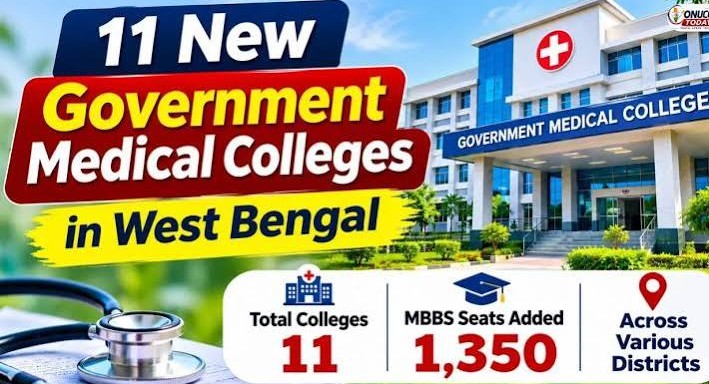
The initiative is expected to strengthen medical education, increase opportunities for students aspiring to pursue MBBS and improve access to healthcare services in districts beyond Kolkata and other major urban centres.
The new institutions are spread across Birbhum, Cooch Behar, South 24 Parganas, Purulia, North Dinajpur, North 24 Parganas, Howrah, Hooghly, Jhargram, Purba Medinipur and Jalpaiguri.
The expansion is particularly important for NEET UG aspirants because the establishment of additional government medical colleges has contributed to increasing MBBS admission capacity in the state. Students from West Bengal will have more opportunities to pursue medical education through government institutions, subject to the approved seat matrix and counselling eligibility requirements.
According to information provided by the Union Health Ministry in Parliament, all 11 medical colleges approved under the scheme were functional.
1,350 Seat+1
West Bengal 11 New Government Medical Colleges: Key Highlights
| Particulars | Details |
|---|---|
|
State |
West Bengal |
|
Total new government medical colleges |
11 |
|
Total MBBS seats added |
1,350 |
|
Implementation |
Three phases |
|
Funding scheme |
Centrally Sponsored Scheme |
|
Implementing authority |
West Bengal Government |
|
Central ministry |
Ministry of Health and Family Welfare |
|
Admission examination |
NEET UG |
|
Counselling authority |
West Bengal Medical Counselling Committee (WBMCC) |
|
Courses |
MBBS |
|
Admission process |
NEET UG counselling |
Complete List of 11 New Government Medical Colleges in West Bengal
The 11 government medical colleges have been established in different districts to improve the geographical distribution of medical education facilities.
The complete list of institutions is provided below.
| S. No. | District | Name of Government Medical College |
|---|---|---|
|
1 |
Birbhum |
Rampurhat Government Medical College and Hospital |
|
2 |
Cooch Behar |
Maharaja Jitendra Narayan Medical College and Hospital |
|
3 |
South 24 Parganas |
Diamond Harbour Government Medical College and Hospital |
|
4 |
Purulia |
Deben Mahata Government Medical College and Hospital |
|
5 |
North Dinajpur |
Raiganj Government Medical College and Hospital |
|
6 |
North 24 Parganas |
Barasat Government Medical College and Hospital |
|
7 |
Howrah |
Sarat Chandra Chattopadhyay Government Medical College |
|
8 |
Hooghly |
Prafulla Chandra Sen Government Medical College |
|
9 |
Jhargram |
Jhargram Government Medical College and Hospital |
|
10 |
Purba Medinipur |
Tamralipto Government Medical College and Hospital |
|
11 |
Jalpaiguri |
Jalpaiguri Government Medical College and Hospital |
These institutions are part of the expansion programme approved under the centrally sponsored scheme.
Digital Sansad+1
Medical Colleges Established in Three Phases
The expansion of government medical colleges in West Bengal has taken place in three phases under the Centrally Sponsored Scheme. The programme was designed to establish medical colleges in underserved districts by attaching them to existing district and referral hospitals.
Phase 1: Establishment of Five Government Medical Colleges
The first phase included five medical colleges in the following districts:
1. Rampurhat Government Medical College, Birbhum.
2. Maharaja Jitendra Narayan Medical College, Cooch Behar.
3. Diamond Harbour Government Medical College, South 24 Parganas.
4. Deben Mahata Government Medical College, Purulia.
5. Raiganj Government Medical College, North Dinajpur.
These institutions helped extend government medical education facilities to districts that previously had limited access to medical colleges.
Phase 2: Establishment of Five More Medical Colleges
The second phase added five institutions in different parts of the state:
1. Barasat Government Medical College, North 24 Parganas.
2. Government Medical College and Hospital, Uluberia, Howrah.
3. Government Medical College and Hospital, Arambagh, Hooghly.
4. Jhargram Government Medical College and Hospital, Jhargram.
5. Government Medical College and Hospital, Tamluk, Purba Medinipur.
This phase further expanded the availability of medical education in southern and western districts of West Bengal.
Phase 3: Establishment of Jalpaiguri Government Medical College
The third phase included one additional government medical college:
- Jalpaiguri Government Medical College and Hospital, Jalpaiguri.
The establishment of this institution strengthened medical education infrastructure in North Bengal and improved access to government healthcare facilities in the region.
Through these three phases, West Bengal completed the establishment of the 11 medical colleges approved under the scheme.
Digital Sansad+1
1,350 MBBS Seats Added: Major Relief for NEET UG Aspirants
One of the most significant outcomes of the expansion is the addition of 1,350 MBBS seats across the 11 government medical colleges, according to the West Bengal Health Department information cited in the report.
The increase in medical seats is important because West Bengal has a large number of students appearing for NEET UG every year.
Admission to government medical colleges is highly competitive, particularly because of the relatively affordable fee structure compared with many private medical institutions.
The additional seats have several potential benefits:
- More opportunities for students seeking government MBBS admission.
- Increased availability of medical education across different districts.
- Reduced geographical concentration of medical colleges in major cities.
- Better access to clinical training facilities.
- Greater opportunities for students from different socioeconomic backgrounds.
- Expansion of the state's future medical workforce.
However, students should remember that the actual number of seats available for admission in any particular academic year depends on the latest National Medical Commission (NMC) approvals and the official counselling seat matrix.
Why Are These New Government Medical Colleges Important for West Bengal?
The establishment of medical colleges in different districts is important not only for increasing MBBS seats but also for improving the state's overall healthcare infrastructure.
Previously, students from several districts had limited options for pursuing medical education close to their hometowns. Similarly, patients requiring specialised treatment often had to travel to larger cities for advanced medical facilities.
The new institutions are expected to address these challenges.
1. Improved access to medical education
Students from districts such as Jhargram, Purulia, Birbhum, Jalpaiguri and Cooch Behar can benefit from the expansion of government medical education facilities closer to their regions.
2. Better healthcare facilities
Government medical colleges attached to hospitals can provide additional infrastructure for patient treatment, diagnostic services and specialist healthcare.
3. Development of rural healthcare
The establishment of medical institutions outside major metropolitan areas can help strengthen healthcare delivery in rural and semi-urban regions.
4. More clinical training opportunities
Medical colleges provide students with opportunities to gain practical experience through hospital postings, clinical departments and supervised patient care.
5. Employment opportunities
The development and expansion of medical colleges can create employment opportunities for doctors, professors, nursing professionals, technicians, administrative personnel and other healthcare workers.
NEET UG Admission to Government Medical Colleges in West Bengal
Admission to MBBS courses in the 11 government medical colleges is based on NEET UG qualification and the prescribed counselling process.
The National Testing Agency (NTA) conducts the NEET UG examination, which is the mandatory entrance examination for undergraduate medical admissions in India.
In West Bengal, the West Bengal Medical Counselling Committee (WBMCC) conducts counselling for state quota MBBS and BDS seats in government and private medical and dental colleges.
The state counselling process generally includes:
- Online registration.
- Payment of the prescribed counselling fee.
- Document verification.
- Publication of the state merit list.
- Online choice filling and choice locking.
- Seat allotment.
- Downloading of the allotment letter.
- Reporting to the allotted medical college.
Candidates seeking admission through the All India Quota must participate in the respective national counselling process.
According to the WBMCC's 2026 counselling information, 85% of state quota undergraduate medical and dental seats are allotted through state-level online counselling.
India
West Bengal Government Medical Colleges: Role of the Central Government
The establishment of the 11 medical colleges has been supported under the Central Government's Centrally Sponsored Scheme for establishing new medical colleges attached to existing district and referral hospitals.
The scheme gives priority to underserved areas and districts that do not have government or private medical colleges.
The funding arrangement for West Bengal is based on a 60:40 cost-sharing ratio between the Central Government and the State Government.
According to the Ministry of Health and Family Welfare's parliamentary response, all 11 approved medical colleges in West Bengal were functional.
Digital Sansad+1
Four More Government Medical Colleges Announced in West Bengal
Apart from the 11 medical colleges established under the three-phase centrally sponsored programme, West Bengal also announced plans for four additional government medical colleges in 2026.
The proposed locations include:
1. Alipurduar.
2. Kalimpong.
3. Dakshin Dinajpur.
4. Paschim Bardhaman.
These announcements represent a separate expansion initiative and should not be confused with the existing 11 colleges.
The proposed institutions are expected to further strengthen medical education and healthcare facilities, particularly in districts where access to advanced medical treatment remains limited.
The Times of India+2
What Should NEET UG Aspirants Know Before Applying?
Students planning to pursue MBBS admission in West Bengal should carefully check the latest admission and counselling notifications.
Although the establishment of additional government medical colleges has expanded medical education opportunities, admission is strictly based on eligibility, NEET UG merit, reservation rules and seat availability.
Candidates should pay attention to the following details:
- Latest NMC-approved MBBS seat matrix.
- College-wise seat availability.
- NEET UG 2026 qualifying requirements.
- West Bengal domicile requirements for state quota admission.
- Category-wise reservation policies.
- State merit list and counselling schedule.
- College-wise fee structure.
- Reporting and document verification requirements.
Students should also verify the regulatory approval and permitted MBBS intake of individual institutions for the relevant academic year before taking admission.
Important Official Websites for Medical Admission Updates
| Authority | Purpose | Website |
|---|---|---|
|
National Medical Commission |
Medical college approvals and seat information |
|
|
West Bengal Medical Counselling Committee |
State NEET UG counselling and allotment |
|
|
National Testing Agency |
NEET UG examination and results |
|
|
West Bengal Health Department |
State healthcare and medical education information |
Conclusion: West Bengal Strengthens Its Position in Medical Education
The establishment of 11 new government medical colleges across West Bengal represents a major step towards expanding medical education and improving healthcare infrastructure.
With 1,350 additional MBBS seats reported through this expansion, students have gained more opportunities to pursue medical education in government institutions across different districts.
The three-phase development programme has extended medical education facilities to several previously underserved regions, including Jhargram, Purulia, Birbhum, Cooch Behar and Jalpaiguri.
Furthermore, the announcement of four additional proposed medical colleges in 2026 indicates the state's continued focus on expanding its medical education network.
The long-term success of this expansion will depend on maintaining high academic standards, ensuring adequate faculty availability, strengthening hospital infrastructure and obtaining the necessary regulatory approvals.
For NEET UG aspirants, these developments offer encouraging prospects for future MBBS admissions in West Bengal.
