

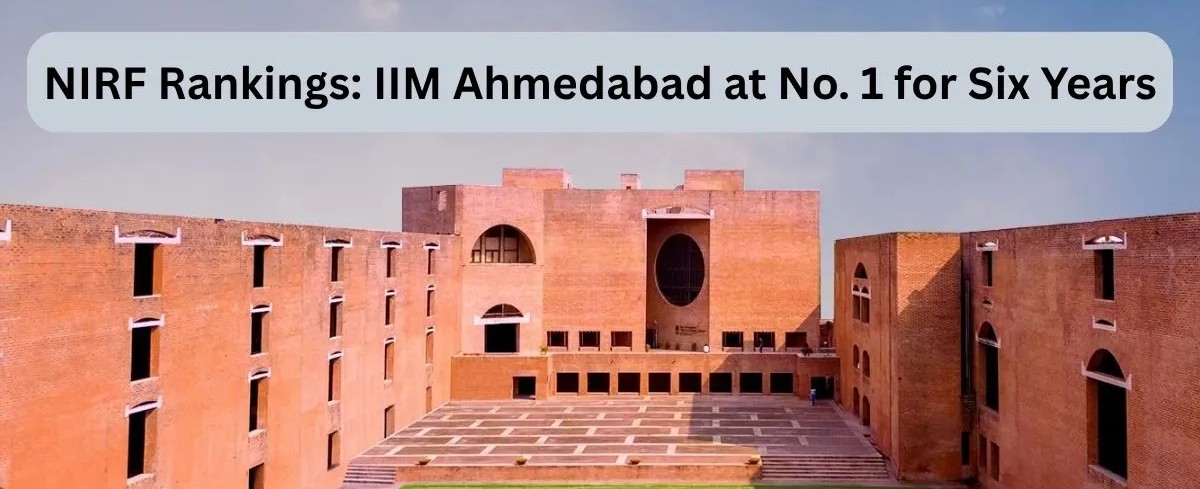
The institute's performance also reflects a significant improvement in the median salary reported for graduates. According to the data submitted for the NIRF rankings, the median salary increased from approximately ₹23.31 lakh in the 2020 report to ₹31 lakh in the 2025 report, representing growth of around 33%.
These trends are particularly relevant for MBA aspirants preparing for management entrance examinations and evaluating India's top business schools. While a high NIRF rank provides an important benchmark, students should also examine placement outcomes, academic resources, research performance, inclusivity and institutional reputation before making their admission decisions.
IIM Ahmedabad NIRF Ranking: Key Highlights
| Particulars | Details |
|---|---|
|
Institution |
Indian Institute of Management Ahmedabad |
|
Location |
Ahmedabad, Gujarat |
|
NIRF category |
Management |
|
Rank in NIRF 2025 |
1 |
|
Consecutive years at Rank 1 |
Six, from 2020 to 2025 |
|
Graduation Outcomes score in 2025 |
98.72 |
|
Teaching, Learning and Resources score in 2025 |
91.84 |
|
Research and Professional Practice score in 2025 |
64.92 |
|
Outreach and Inclusivity score in 2025 |
72.01 |
|
Perception score in 2025 |
93.26 |
|
Median salary reported in the 2025 ranking data |
₹31 lakh |
|
Median salary reported in the 2020 ranking data |
₹23.31 lakh |
|
Approximate growth in median salary |
33% |
IIM Ahmedabad NIRF Ranking 2020–2025: Six-Year Score Analysis
IIM Ahmedabad has maintained the top position in the NIRF Management category throughout the six-year period from 2020 to 2025. Its overall ranking has remained unchanged, but its performance across the five assessment parameters has varied.
The NIRF framework evaluates management institutions using Teaching, Learning and Resources (TLR), Research and Professional Practice (RP), Graduation Outcomes (GO), Outreach and Inclusivity (OI), and Perception (PR). Each parameter examines a different aspect of institutional performance.
The following table presents IIM Ahmedabad's scores across the five parameters for each ranking year.
| NIRF Edition | Rank | TLR | RP | GO | OI | PR |
|---|---|---|---|---|---|---|
|
India Rankings 2020 |
1 |
92.87 |
63.06 |
98.46 |
66.78 |
95.99 |
|
India Rankings 2021 |
1 |
91.41 |
65.09 |
99.43 |
70.01 |
98.53 |
|
India Rankings 2022 |
1 |
92.76 |
63.22 |
99.39 |
68.13 |
98.62 |
|
India Rankings 2023 |
1 |
92.55 |
63.45 |
99.14 |
69.66 |
96.14 |
|
India Rankings 2024 |
1 |
91.88 |
63.89 |
98.71 |
71.72 |
96.81 |
|
India Rankings 2025 |
1 |
91.84 |
64.92 |
98.72 |
72.01 |
93.26 |
Note: The figures above are the individual parameter scores reported for the respective NIRF editions. They should not be confused with the institution's overall composite score.
The data indicates that IIM Ahmedabad's strongest and most consistent area has been Graduation Outcomes. Its TLR score has also remained above 91 throughout the period. Meanwhile, the Research and Professional Practice score has improved only modestly, and the Perception score has declined from its 2022 peak.
Despite these fluctuations, the institute has retained the top rank, demonstrating that its performance across the full assessment framework has remained sufficiently strong to sustain its leadership position.
Why Has IIM Ahmedabad Maintained Rank 1 Despite Changes in Its Scores?
A decline in one ranking parameter does not automatically result in a lower overall rank. NIRF evaluates institutions using multiple indicators, and their combined performance determines the final position.
In IIM Ahmedabad's case, strong graduation outcomes and consistently high teaching and learning scores have supported its overall performance. The improvement in outreach and inclusivity has also contributed positively to its assessment profile.
Although the perception score has weakened, it remains a high score in absolute terms. The institute's continued performance across several other parameters has helped it retain the top position in the Management category.
This distinction is important for students interpreting rankings. A change in an individual score should be examined alongside the institution's other scores, the methodology used for evaluation and the performance of competing institutions.
IIM Ahmedabad's Graduation Outcomes Remain Its Strongest Area
Graduation Outcomes have been one of IIM Ahmedabad's most prominent strengths. The institute recorded a score of 98.72 in 2025, following scores above 98 in every year shown in the six-year analysis.
This parameter evaluates aspects of student progression and outcomes, including timely graduation and placement-related indicators as specified by the NIRF methodology.
The placement information submitted for the ranking reports also indicates that a substantial proportion of students completed their programmes within the prescribed period and secured employment.
In the 2025 report, the institute recorded 444 students graduating in the minimum stipulated time, with 434 students reported as placed. These figures reinforce the strength of its graduation outcomes, although placement figures should always be interpreted in the context of the particular graduating cohort and the reporting methodology.
For prospective MBA students, this information is useful because academic reputation is only one component of a management programme's value. Career opportunities, employer engagement and the ability to complete the programme successfully are also important considerations.
IIM Ahmedabad Median Salary Increased by Around 33% in Six Years
One of the notable findings in the six-year analysis is the rise in IIM Ahmedabad's reported median salary. The median increased from ₹23.31 lakh in the 2020 NIRF report to ₹31 lakh in the 2025 report.
The median salary represents the middle value in a salary distribution and offers a different perspective from the average salary, which can be influenced by a relatively small number of very high offers.
The reported increase suggests stronger salary outcomes over the period, although candidates should remember that figures from different graduating cohorts are not a guarantee of the salary an individual student will receive.
IIM Ahmedabad Placement and Median Salary Data: 2020–2025
| NIRF Report Year | First-Year Intake Year | First-Year Students Admitted | Graduating Year | Students Graduating in Minimum Time | Students Placed | Median Salary |
|---|---|---|---|---|---|---|
|
2020 |
2017–18 |
439 |
2018–19 |
432 |
424, subsequently updated to 432 |
₹23,31,400 |
|
2021 |
2018–19 |
445 |
2019–20 |
441 |
439 |
₹25,00,003 |
|
2022 |
2019–20 |
435 |
2020–21 |
429 |
428 |
₹27,60,000 |
|
2023 |
2020–21 |
441 |
2021–22 |
432 |
431 |
₹30,00,000 |
|
2024 |
2021–22 |
441 |
2022–23 |
435 |
423 |
₹31,00,000 |
|
2025 |
2022–23 |
444 |
2023–24 |
444 |
434 |
₹31,00,000 |
Note: Intake, graduation and placement figures correspond to the cohorts reported in each NIRF submission. The 2020 placement entry reflects the updated figure noted in the reported data.
The median salary rose steadily from approximately ₹23.31 lakh to ₹30 lakh in the 2023 report, before reaching ₹31 lakh in the 2024 report. It remained at ₹31 lakh in the 2025 report.
This means that although the median salary did not increase between the last two reports, the longer-term trend remains positive. The approximately 33% increase over the six-year period highlights the institute's strong employment outcomes.
However, students should not evaluate a management programme on salary figures alone. Programme fees, living expenses, career preferences, industry exposure, the range of roles offered and long-term professional development should also form part of the decision.
Perception Score Falls to a Six-Year Low
The Perception score is the parameter that has attracted particular attention in the six-year comparison. IIM Ahmedabad's score declined to 93.26 in 2025, its lowest level in the period examined.
The score had reached 98.62 in 2022 before falling to 96.14 in 2023. It recovered to 96.81 in 2024 but then dropped to 93.26 in 2025.
The NIRF perception assessment draws on stakeholder views, including those of employers and academic peers, under the framework's prescribed methodology. It is intended to capture an institution's standing and reputation beyond the numerical measures of teaching resources, research and graduation outcomes.
A lower score does not, by itself, establish that an institution's academic quality or employer recognition has deteriorated in every respect. It indicates a change in the perception component of the assessment and should be considered alongside the remaining parameters.
In IIM Ahmedabad's case, the fall has not translated into a lower NIRF Management rank. Its strong graduation outcomes and other high scores have helped sustain its overall position.
For MBA aspirants, the key lesson is to distinguish between a decline in one metric and a decline in the institution's overall performance. Rankings offer useful information, but they do not capture every aspect of the student experience or every career outcome.
Research and Professional Practice: A More Gradual Improvement
Research and Professional Practice has remained one of the comparatively lower-scoring parameters in IIM Ahmedabad's NIRF profile.
The score increased from 63.06 in 2020 to 64.92 in 2025. Although this represents an improvement, the change has been relatively modest compared with the movement in the Outreach and Inclusivity score.
The RP parameter assesses research-related and professional contributions under the NIRF methodology. Such measures can include research publications, their impact, intellectual property and other recognised scholarly or professional outputs, depending on the applicable framework.
Research performance matters for management education because it contributes to the development of new business knowledge, informs teaching and supports engagement with industry and public policy.
The six-year figures suggest that research remains an area where the institute's progress has been more gradual than its consistently strong graduation outcomes. However, the parameter score alone should not be treated as a complete assessment of the quality, relevance or influence of all research produced by the institute.
Outreach and Inclusivity Score Shows Significant Improvement
In contrast to the fall in perception, IIM Ahmedabad's Outreach and Inclusivity score has improved considerably.
The score rose from 66.78 in 2020 to 72.01 in 2025, an increase of 5.23 points over the six-year period.
The OI parameter assesses aspects of institutional access and inclusivity under the NIRF framework. Its indicators are intended to examine how institutions serve students from different backgrounds and address relevant dimensions of access and participation.
The increase indicates improvement in this component of IIM Ahmedabad's ranking profile. It also demonstrates why a full assessment of an institution should consider all five parameters rather than focusing only on the areas where scores have declined.
For students comparing management schools, inclusivity is an important consideration alongside academic quality, employment outcomes and research. A strong learning environment should support students from diverse backgrounds and provide access to meaningful educational opportunities.
Teaching, Learning and Resources: Consistently High Scores
IIM Ahmedabad's Teaching, Learning and Resources score remained above 91 in each of the six ranking editions examined.
The score stood at 92.87 in 2020 and 91.84 in 2025. While the latest figure is lower than the 2020 score, the difference is relatively small across the period.
The TLR parameter considers elements such as faculty resources, student strength, qualifications, financial and physical resources, and other measures defined in the NIRF methodology.
A consistently high TLR score supports the view that the institute has maintained a strong academic and institutional foundation. However, students should also examine programme-specific factors, including curriculum design, teaching methods, elective choices, faculty interests and opportunities for practical learning.
The parameter is most useful when considered with the other indicators rather than treated as a standalone measure of educational quality.
What Do the Six-Year NIRF Scores Tell MBA Aspirants?
The six-year analysis offers several lessons for students preparing to apply to leading management institutions.
First, consistency matters. IIM Ahmedabad has remained at Rank 1 in the NIRF Management category from 2020 through 2025. Its sustained position reflects high performance across multiple assessment dimensions.
Second, placement outcomes deserve close attention. The reported median salary rose by around 33% between the 2020 and 2025 reports. Graduation outcomes have also remained one of the institute's strongest ranking parameters.
Third, no single ranking parameter tells the complete story. The perception score declined, but the institute retained the top position. The improvement in outreach and inclusivity, together with strong graduation outcomes and TLR scores, provides important context.
Fourth, research is another factor to examine. The RP score improved only gradually over the period, highlighting the importance of looking beyond placement statistics when assessing a business school's academic contribution.
Finally, prospective students should evaluate how well a programme matches their career goals. An institution's ranking cannot independently determine whether its curriculum, location, fees, campus environment or employment opportunities are right for a particular applicant.
How Should Students Use NIRF Rankings When Choosing an MBA College?
The NIRF Management ranking is a useful starting point for comparing business schools, but it should be one element of a broader evaluation.
Before selecting an MBA programme, candidates should consider:
- Overall ranking and subject ranking: Check the institution's position in the relevant category and compare it with other business schools.
- Placement outcomes: Review median salary, placement participation and the types of roles and industries available.
- Academic quality: Examine the curriculum, faculty expertise, teaching resources and opportunities for specialisation.
- Research performance: Consider the institution's research culture, publications and engagement with business and public policy.
- Fees and return on investment: Compare tuition fees and living expenses with realistic career and salary expectations.
- Admission requirements: Check the relevant entrance examination, eligibility criteria, selection stages and application deadlines.
- Personal career goals: Evaluate whether the programme supports the industry, function or specialisation the student wants to pursue.
Candidates should consult the latest official admission notifications before applying. Rankings and historical placement figures can help inform a decision, but they should not replace a careful review of programme-specific information.
Conclusion
IIM Ahmedabad's NIRF performance from 2020 to 2025 highlights both its long-standing strengths and areas where individual scores have changed. The institute retained the No. 1 position in the Management category for six consecutive years, supported by exceptionally strong graduation outcomes and consistently high teaching and learning scores.
Its median salary rose from approximately ₹23.31 lakh in the 2020 report to ₹31 lakh in the 2025 report, an increase of around 33%. At the same time, the Perception score declined to 93.26, its lowest level in the six-year period, while Outreach and Inclusivity improved by 5.23 points.
These contrasting trends underline the importance of interpreting institutional rankings in context. For MBA aspirants, IIM Ahmedabad's record provides a useful example of how a leading business school can retain its overall position even as individual assessment scores move in different directions.
Students planning their management education should use the NIRF ranking alongside placement information, academic resources, research performance, programme costs and personal career objectives to make a well-informed choice.
